Home > Products > Covers > CONSERVATEK® by CST > Steel Roofs and Covers
Conservatek® by CST® can provide a wide range of steel roofs and decks to match your specific application. From economical flat covers, knuckle roofs and trough decks, to high performance, highly competitive ESRs with smooth interiors.
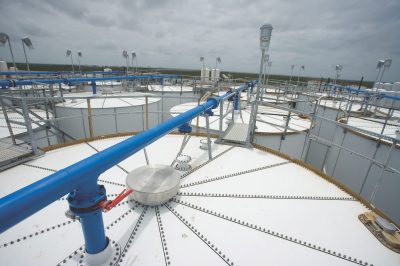
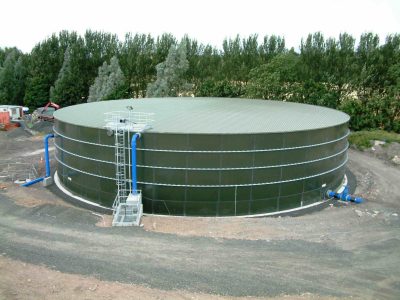
CST’s supported and unsupported Conservatek flat steel decks or roofs provide an economical solution to many liquid and dry containment needs where safe, regular access to accessories on the deck is desired. Based on years of experience and field-proven assembly this type of cover is an excellent option for numerous applications. Flat steel decks were one of CST’s earliest designs for tank covers and they’re still used often today. We have optimized the design through finite elements analysis, proprietary design programs, new materials and 130+ years of field experience.
Conservatek flat deck roofs can usually be constructed up to 32 feet (9.8 meters) and up to 100 feet (33.8 meters) supported, though we have built spans in excess of 120 feet. Supported decks can be center-column supported or contain multiple columns depending on the size and loading.
Conservatek’s flat decks can be designed to accommodate a variety of accessories, including valves and hatches. Safe and easy access to accessories for maintenance and use is important, so our near-flat design and standard safety railings are significant benefits.
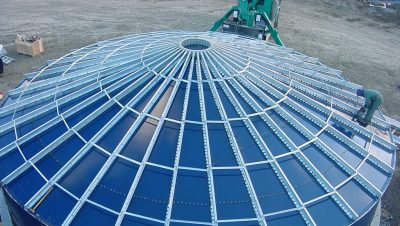
Conservatek’s Externally Supported Roofs are built to accommodate higher static and dynamic loads, and applications with higher pressures and vacuum conditions, or where a smooth inner roof surface is beneficial. Because they’re specifically designed to accommodate a roof-mounted center mixer, installation and service of center-supported loads is easily accomplished.
Design and cost optimization has made the Conservatek ESR a high quality, highly competitive cover solution for the digester and other markets’ needs. When CST® redesigned its ESR, higher performance was not the only result.
Conservatek’s ESR is designed with a smooth, unobstructed inner surface. So it’s ideal for applications where internal corrosion of internal structural members is a concern, maintenance of internal structural members is cost prohibitive, and ease of cleaning is desirable.
Since its origin as a dry silo cover, the knuckle roof’s application has greatly expanded to a variety of liquid and dry storage needs. For small-diameter tanks in areas of higher environmental loads but minimal dynamic loads, a knuckle roof is the most economical cover. Easy installation adds to the cost benefits of this type of cover.
Having been integrated onto silos and tanks for over 60 years, there is a tremendous amount of field data validating the knuckle roof design. Knuckle roofs have a proven life expectancy, even in extremely demanding applications such as leachate tanks and digesters.
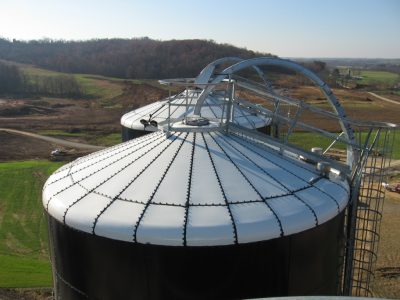
Conservatek knuckle roofs are limited to 31 feet (9.5 meters) in diameter, which makes them ideal for silo covers. Most sizes are predesigned and have reduced manufacturing times. Unlike flat steel roofs, knuckle roofs have a high slope. This makes knuckle roofs an ideal solution for silos and small diameter tanks in high snow load areas. Its steep slope also minimizes the need for internal structural support but may also be a hindrance to regular access or access with loads.
Conservatek’s knuckle roofs are predominantly manufactured in Vitrium® glass-fused-to-steel. They can also be manufactured in stainless steel and other materials. CST’s engineers can match your needs with the material and design to meet the application requirements.
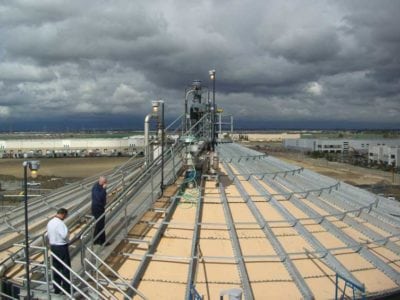
Conservatek’s trough deck covers are primarily designed for areas with low environmental loads where cover cost supersedes total containment and durability requirements. Minimal construction costs, locally available components and no special construction tools make this the ideal solution for moderate-diameter, less stringent applications.
When the diameter is small and the loads are minimal, beams can be used to span the tank, eliminating the need for any internal, vertical support columns. For higher load applications and when tank diameters are larger, internal beams can be supported by vertical columns. These columns do add to the complexity of cleaning and maintenance needs.